Implementing Radix Trie
While reading the book, Let’s GO Further. In it we are using the HTTP routing using the httprouter package
to make our API’s. The one of the benefit the author tell about this package is that it uses the Radix
Trie for url path matching.
So, me being me, thought what is Radix Trie why not just build it? And woilaaa, here we are in the article and we are just going to do exactly that.
Implementing Trie Data Structure
Before, implementing the main talking point of our article, let’s get the basics and build the parent of the Radix Trie that is Trie(didn’t expect him to be here?).
The idea is simple with the Trie, its like a Binary Tree but it has many childrens, usually 26 (cause english has these many letters). And each node hold Two things 1) a letter, 2) is it a word?
This is best for data-structure that we may need on a string. Like autocomplitions?
The benefit that a Trie has over the Binary Tree is that it does not require any balancing algorithm.
Let’s create some test’s first defining what we want.
trie_test.go
package whatever
import ( "testing"
"github.com/stretchr/testify/assert")
func TestTrie(t *testing.T) { tr := NewTrie()
for _, w := range []string{"go", "gopher", "Game", "goal"} { err := tr.Insert(w) assert.NoError(t, err) }
for _, want := range []string{"go", "gopher", "game", "goal"} { err := tr.Search(want) assert.NoError(t, err) }
err := tr.Search("ghost") assert.ErrorIs(t, err, ds.ErrNoSuchWord)
err = tr.Search("g") assert.ErrorIs(t, err, ds.ErrNoSuchWord)
// Deletion & Search err = tr.Delete("go") assert.NoError(t, err)
err = tr.Search("go") assert.ErrorIs(t, err, ds.ErrNoSuchWord)
err = tr.Delete("gopher") assert.NoError(t, err)
err = tr.Search("gopher") assert.ErrorIs(t, err, ds.ErrNoSuchWord)
err = tr.Search("game") assert.NoError(t, err) err = tr.Search("Goal") assert.NoError(t, err)
err = tr.Delete("carbon") assert.ErrorIs(t, err, ds.ErrNoSuchWord)}We will create the structure’s that will hold the values. So we want a node thingy that will hold
- value,
- children pointers,
- parent for tranversing up, and
- is flag that will tell if it is a word or nah.
Then the main trie, that will have a root, with no value in it.
We will also define the error types, its optional, if you want you can choose not return errors.
trie.go
package whatever
import ( "error")
// defining all the error types that we would want to returnvar ( ErrNoSuchWord = errors.New("no such word in trie") ErrNotWord = errors.New("not word") ErrEmptyWord = errors.New("empty word") ErrInvalidRune = errors.New("invalid character"))
type trieNode struct { value rune children [26]*trieNode parent *trieNode isWord bool}
func NewTrieNode(val rune) *trieNode { return &trieNode{value: val}}
type Trie struct { head *trieNode}
func NewTrie() *Trie { var r rune return &Trie{head: NewTrieNode(r)}}
// a helper function to get the index value// will be helpfulfunc getIndex(r rune) (int, error) { if r < 'a' || r > 'z' { return -1, ErrInvalidRune } return int(r - 'a'), nil}The first method we would want to build is Search.
The algo will go like this
-
Traverse the given word,
-
Check if the character is present in the trie, if it is then we move onto that, and
-
If the character is not present, then the word is not in the trie and return error.
Lastly, if every thing goes well we will be at the word’s last character node. Now if it is not a word return error else nothing.
import ( "error" "strings")func (t *Trie) Search(word string) error { if word == "" { return ErrEmptyWord }
cur := t.head for _, r := range strings.ToLower(word) { idx, err := getIndex(r) if err != nil { return err }
child := cur.children[idx] if child == nil { return ErrNoSuchWord } } cur = child }
if cur.isWord { return nil } return ErrNoSuchWord}Now, let’s get to the Insert method. It’s simple, we want
- To traverse the word,
- If the character is present in the trie cool, we move to the next character,
- If not then we create a new trie node, and move on
Lastly, we will set the word flag to be true.
func (t *Trie) Insert(word string) error { if word == "" { return ErrEmptyWord } cur := t.head
for _, r := range strings.ToLower(word) { idx, err := getIndex(r) if err != nil { return err }
child := cur.children[idx] if child == nil { child = NewTrieNode(r) child.parent = cur cur.children[idx] = chil } cur = child } cur.isWord = true return nil}The last method Delete, things we want to
- traverse to the bottom of the trie, if we cannot that means the word is not in the trie, return err
- check if the last node is a word, if not return error it is not a word, if it is true then mark it false
- now, traverse up remove the node.
func (t *Trie) Delete(word string) error { if word == "" { return ErrNotWord }
cur := t.head for _, r := range strings.ToLower(word) { idx, err := getIndex(r) if err != nil { return err }
child := cur.children[idx] if child == nil { return ErrNoSuchWord } cur = child }
if !cur.isWord { return ErrNotWord } cur.isWord = false
parent := cur.parent for parent != nil { if t.hasChildren(parent) || cur.isWord { break } idx, err := getIndex(cur.value) if err != nil { return err }
parent.children[idx] = nil cur = parent parent = parent.parent } return nil}
func (t *Trie) hasChildren(parent *trieNode) bool { count := 0 for _, pointer := range parent.children { if pointer != nil { count++ } } if count > 1 { return true } return false}We done with our Trie implementation, now run the test, we should be passing all these tests.
Implementing Radix Trie Data Structure
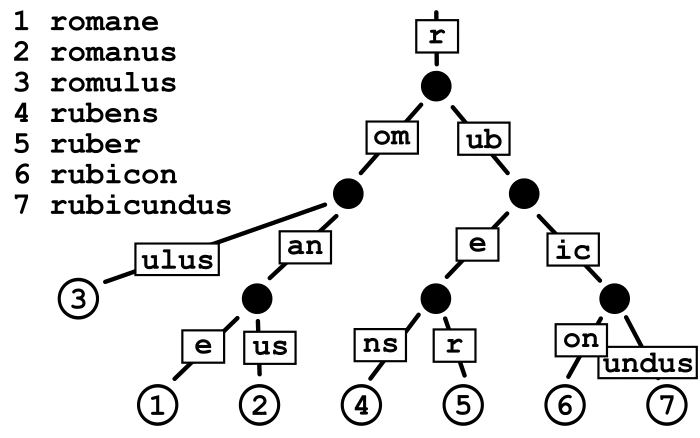
Now to the main, agenda of the day. The normal Trie has one problem, it is not very space efficient. It creates node for every letter of the word.
That’s where the Radix Trie comes in. Radix Trie compact the words. Let’s see an example with a beautiful ascii art.
RO OT | / \ bankai wa / \ ste t / \ ch erHere we have the words bankai, water, waste, watch. The word bankai is present as a whole word in the trie. The latter words a split wa, ste, t, ch, er. All the last nodes are marked as words.
Let’s get started with the strucuture.
- we want an edge that will have the label and the next node,
- the node that will have isWord flag, hashmap with key as character and the value with the edge,
- lastly, the main trie structure.
You can create the tests, like we did above.
radix.go
package whatever
type rdxE struct { label string next *rdxN}
func newRdxE(label string ) *rdxE { return &rdxE{label: label, next: newRdxNode(false)}}
func newRdxEWithNext(label string, next *rdxN) *rdxE { return &rdxE{label: label, next: next}}
type rdxN struct { edge map[rune]*rdxE isWord bool}
func newRdxNode(isWord bool) *rdxN { return &rdxN{edges: make(map[rune]*rdxE), isWord: isWord}}
func (r *rdxN) addEdge(label string) { r.edges[rune(label[0])] = newRdxE(label)}
func (r *rdxN) addEdgeWithNext(label string, next *rdxN) { r.edges[rune(label[0])] = newRdxEWithNext(label, next)}
func (r *rdxN) getTransition(transitionChar rune) *rdxE { return r.edges[transitionChar]}
type RdxTrie struct { root *rdxN}
func NewRadixTrie() *RdxTrie { return &RdxTrie{root: newRdxNode(false)}}The node will have edge’s map as rune -> edge, and isWord flag tells whether upto this word it is a word.
The edge will have the label, that will have the compact word if possible and the pointer to the next node.
The basic function Insert, Search & Delete. We separate the these because we are going to use the
recursion (whoa… that scared me). It’s is a best idea to make a new function which will do the recursion for us
(that’s what I’ve heard).
func (r *RdxTrie) Search(word string) bool { return r.search(r.root, word)}
func (r *RdxTrie) Insert(word string) error { if word == "" { return ErrEmptyWord } r.insert(r.root, word) return nil}
func (r *RdxTrie) Delete(word string) { r.delete(r.root, word)}Firstly, the Search. The Idea
- get edge with the first character of the searching word
- if the edge is null, return false
- if the edge label does match the prefix of the searching word
- if the edge label and the word match AND it is a word, return true
- cut the prefix, then recurse with the cutted word, and the next node.
Let’s see it in action
func getRuneAt(word string, idx int) rune { return rune(word[idx])}
func (r *RdxTrie) search(cur *rdxN, word string) bool { // base case if word == "" { return cur.isWord }
transistionChar := getRuneAt(word, 0) childEdge := cur.getTransition(transitionChar)
if childEdge == nil { return false }
if !strings.HasPrefix(word, childEdge.label) { return false }
after, found := strings.CutPrefix(word, childEdge.label) if !found { return false }
return r.search(childEdge.next, after)}Now, for the Insert method. There are mutlitple case.
- The word is not present in the trie, so simply add,
- We want to add the word, and its prefix is present(e.g. word to be added “slower”, “slow” already present),
- The opposite of the 2 (e.g. “slower” is present, want to add “slow”)
- The word to be added and the word in the tree share the prefix (e.g. adding “waste”, and “water” is present)
- The word is already present, mark it as word.
func (r *RadixTrie) commonPrefix(s1, s2 string) int { if len(s1) < 1 || len(s2) < 1 { return -1 } minLen := min(len(s1), len(s2)) cmnPreLen := -1
for i := range minLen { if s1[i] != s2[i] { break } cmnPreLen++ }
return cmnPreLen}
func (r *RdxTrie) insert(curr *rdxN, word string) { if word == "" { return }
transitionChar := getRuneAt(word, 0) childEdge := curr.getTransistion(transitionChar)
// case 1: word not present in the trie if childEdge == nil { curr.addEdge(word) childEdge = curr.getTransition(transitionChar) childEdge.next.isWord = true
return }
// Case 5: the word is already present as a label if word == childEdge.label { childEdge.next.isWord = true return }
cmnPreIdx := r.commonPrefix(word, childEdge.label)
// Case 2: adding word "slower", "slow" is present if cmnPreIdx+1 == len(childEdge.label) { suffix := word[cmnPreIdx+1:] r.insert(childEdge.next, suffix) return }
// Case 3: adding word "slow", "slower" is present if cmnPreIdx+1 == len(word) { prefix := word[:cmnPreIdx+1] suffix := childEdge.label[cmnPreIdx+1:] delete(curr.edges, transitionChar) // add the prefix word curr.addEdge(prefix) newChildEdge := curr.getTransition(transitionChar) newChildEdge.next.isWord = true // recursive call r.insert(newChildEdge.next, suffix) return }
// Case 4: adding word "waste", "water" is present // so the common Prefix idx len will not be equal to // the label or the word itself prefix := word[:cmnPreIdx+1] wordSuffix := word[cmnPreIdx+1:] labelSuffix := childEdge.label[cmnPreIdx+1:] delete(curr.edges, transitionChar) // add the prefix word curr.addEdge(prefix) newChildEdge := curr.getTransition(transitionChar) // if the prefix itself is a complete word if len(wordSuffix) == 0 { newChildEdge.next.isWord = true } // reatach the old label suffix under the new prefix newChildEdge.next.addEdgeWithNext(labelSuffix, childEdge.next) // add the new word's suffix if len(wordSuffix) > 0 { newChildEdge.next.addEdge(wordSuffix) newChildEdge.next.getTransition(getRuneAt(wordSuffix, 0)).next.isWord = true }
}Now, the Delete, we want to traverse and get to the end word, and on the way back up
want to remove uncessary nodes.
func (r *RadixTrie) delete(cur *rdxN, word string) *rdxN { if word == "" { return nil }
transitionChar := getRuneAt(word, 0) edge := cur.getTransition(transitionChar)
if edge == nil { return nil }
if edge.label == word { edge.next.isWord = false return cur }
cmnPrefix := r.commonPrefix(word, edge.label) suffix := word[cmnPrefix+1:]
del := r.delete(edge.next, suffix) if del != nil { delete(cur.edges, getRuneAt(suffix, 0)) }
return cur}And know, we are done with our Radix Trie implementation.
Do check the implementation, and let me know if there is any edge case that I might be missing.
Afterwords
After days of smashing my head, I got the gist of implementing the Radix Trie.
Just know this,
Reinvent the wheel, so that you can learn how to invent wheel
– a nobody
References
- Opengenus Radix Trie
- Opengenus Trie
- ChatGPT (for some edge cases, that might have missed.)